


Here’s the part no one tells you when you start building a product:
The most expensive mistakes happen before development even starts.
Choosing the wrong problem.
Targeting the wrong user.
Prioritizing the wrong features.
Making assumptions instead of validating them.
Product discovery isn’t a “nice-to-have.”
Every year, thousands of new products enter the market; yet 70–90% of them fail.
Not because the engineering team wrote bad code.
Not because the UI was slightly off.
And rarely because the technology wasn’t “advanced enough.”
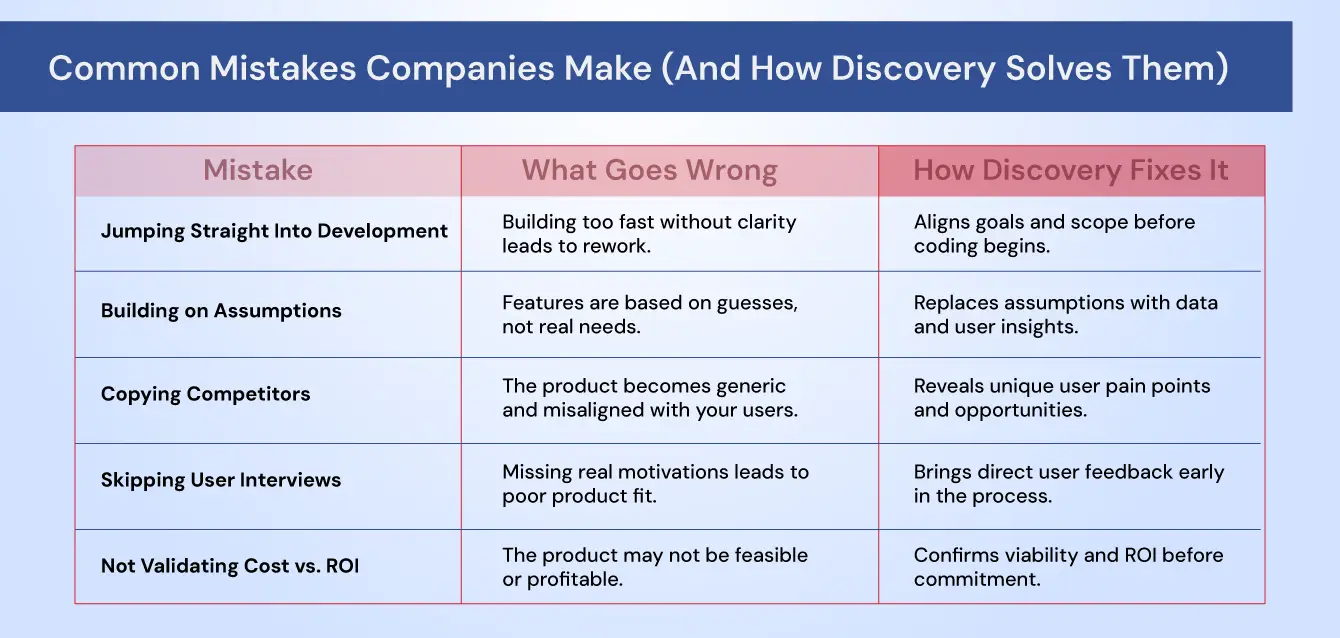
Most products fail long before development even begins. They fail because teams misunderstand the problem, misjudge the user, or jump straight into building based on assumptions.
They fail due to misalignment between business, product, and engineering, unclear priorities, and a poor understanding of what the market truly needs.
In other words: Products don’t fail at launch. They fail at the starting line.
This is why the Product Discovery stage is so critical. It’s where the real truth surfaces:
- What problem is worth solving
- Who actually has that problem
- What solution creates real value
- Whether the idea is worth building at all.
Product Discovery doesn’t slow you down. It prevents you from spending months (and money) building the wrong thing.
Why Product Discovery Matters More Than Anything Else?
- Prevents Building the Wrong Product: Product discovery forces teams to validate the problem before jumping into solutions. It aligns user needs, business goals, and technical feasibility, ensuring you build something people actually want. This alone saves months of expensive rework.
- Saves Time, Money & Engineering Hours: When you validate early, you avoid the endless cycle of building → fixing → rebuilding. Discovery trims unnecessary scope and prevents engineering teams from spending weeks on features that won’t matter.
- Reduces Risk & Uncertainty: Most product failures come from untested assumptions. Discovery uncovers these early, so you’re not relying on guesswork or gut-driven decisions. Every step forward becomes evidence-backed, not assumption-led.
- Sharpens Problem–Solution Fit: Great products solve painful, valuable problems. Discovery helps you pinpoint the real job users are trying to get done, not just what they say they want. This creates stronger product–market alignment from day one.
- Improves Alignment Across Teams: Discovery creates a shared understanding of the problem, the user, and the success metrics. Product, Design, Engineering, and Business teams start from the same place, reducing friction and miscommunication later.
- Creates Faster, Better Iterations: Prototypes built during discovery reveal issues before they reach development. This encourages rapid experimentation, faster learning, and cleaner iterations, leading to a product that evolves the right way.
What Happens During Product Discovery?
Product Discovery is not a brainstorming phase; it’s a structured investigation into whether your idea deserves to exist. Each step brings clarity, reduces risk, and ensures you build with purpose instead of assumptions.
Step 1: Understand the Problem
Before you sketch screens or discuss features, you need to understand the real problem users face.
This involves:
- User interviews to uncover motivations, frustrations, and current workarounds
- Shadowing or observation to see how users behave in real contexts
- Customer data analysis to identify patterns in usage, complaints, or drop-offs
The goal isn’t to confirm your idea; it’s to discover what’s actually broken.
Step 2: Validate the User
Many products fail simply because they target “everyone” and end up helping no one. Discovery helps define:
- Who exactly are you building for
- Their behaviors, needs, and motivations
- The Ideal Customer Profile (ICP) and any sub-segments worth prioritizing
With user clarity, every later decision, from UX to feature planning, becomes sharper and more focused.
Step 3: Validate the Problem
Even if users express frustrations, not all problems are worth solving. Here, you assess:
- Is the problem real?
- Is it painful enough for users to take action?
- Is it frequent or just an occasional annoyance?
- Are users currently paying for solutions or workaround tools?
This step prevents teams from building solutions to “meh” problems that won’t drive adoption.
Step 4: Explore Solutions
Once the problem and user are validated, the team starts exploring potential solutions. This stage includes:
- Brainstorming and ideation sessions
- Journey mapping to visualize how the user interacts with potential flows
- Sketches, wireframes, or quick prototypes to express concepts visually
The purpose is to explore multiple possibilities, not lock into the first idea that sounds good.
Step 5: Validate the Solution
Now it’s time to test whether the proposed solution actually works for the user. This typically involves:
- Low-fidelity prototypes that simulate the experience
- User walkthroughs to observe reactions and gather feedback
- Iterative cycles to refine UX, flows, and feature priorities
A good discovery process catches usability issues, misunderstandings, and unnecessary complexity early, before developers touch the code.
Step 6: Technical & Business Feasibility
Even if a solution is desirable, it must also be feasible and viable. This includes:
- Technical feasibility:
- Can we build this with current tech?
- Do we need new infrastructure, integrations, or research?
- Business feasibility:
- Does it align with revenue goals?
- Will users pay for it?
- What does the ROI look like?
- Scalability:
- Will it work for 100 users the same way it does for 10?
- Can the architecture support the long-term vision?
This final step ensures you’re not only building the right thing, but building it in the right way.
How Aximise Helps Companies With Product Discovery?
At Aximise, we treat Product Discovery as the foundation of every successful build. Our approach ensures you don’t just create a product; you create the right product.
- Strategy-First Approach: We begin by aligning business goals, user needs, and long-term vision. This helps teams avoid guesswork and ensures every decision supports measurable outcomes.
- Research + Prototyping: Through user research, journey mapping, and rapid prototyping, we uncover the real problems worth solving and visualize solutions early, long before engineering gets involved.
- Fast Validation Cycles: We run quick, iterative tests with real users to validate assumptions, refine concepts, and eliminate risk early. This speeds up learning while keeping costs low.
Clarity Before Coding: By the end of discovery, you have a clear problem statement, prioritized features, validated solution flows, and a confident roadmap; so development starts with focus, not uncertainty.
Most products don’t fail at launch. They fail at the beginning—when teams skip validation, assume user needs, and start building without clarity. Product Discovery changes that. It ensures you’re solving the right problem, for the right user, with the right solution before committing time, budget, and engineering effort.
A strong discovery process gives you:
- Alignment across teams
- Evidence-based decisions
- Faster development
- Lower risk
- A product users actually want
When done well, Discovery becomes your unfair advantage. It saves you from expensive mistakes and sets your product up for long-term success.
If you’re ready to validate your idea, reduce uncertainty, and build with confidence, start with Discovery; before you start building.
Build smarter. Launch faster. Grow stronger with Aximise.